11 May, 2009

Building a Strategic Promotional Plan


A goal is a dream until you make a plan. And the plan needs to be strategic otherwise it won't work.

A strategy is a direction - a way of heading. This is not something that already has the tactics in place. Think of a chess strategy, or war strategy - these don't have any step-by-step procedures in place that if a single thing goes wrong the whole strategy falls apart. That same thing is true of any strategy, including your promotional one. The strategy isn't a tresure map. It simply outlines the direction. A strategy will rarely change, but the tactics you use to implement the strategy might - and probably will - depending upon what happens along the way.

No matter what kind of business you're in, you need to operate strategically, and that includes the promotional activity you undertake. Too many times a 'promotional plan' is hit and miss. It's buying an ad somewhere or running a competition. If there's no strategy behind the tactics, then it's like throwing fistfuls of money into the air. Here's an outline of the basic steps for creating a strategic promotional plan. It will ensure your promotional activity is targeted, reflects the overarching goals of your marketing plan, delivers awesome ROI, and gives you the best opportunity for success. It works for every kind of business, whether you're a CEO of a startup, a Fortune 500 company or a mommyblogger wanting to take the next step.

Step 1: Situation Analysis:

If you're an operating business, you'll probably have done a SWOT analysis (Strengths, Weaknesses, Opportunities and Threats) as part of your business or marketing plan already. That's where you'll have looked at the overall place of your product and its distribution in the marketplace. If you're smaller in scope, you might not have thought too much about it before. That's not a problem - this is where you start to think of yourself as a company! In your strategic promotional plan you'll want to do a specific SWOT analysis on how your promotions are working, should work and how you want them to work. Look purely at the SWOT of your product's promotions and its relationship to competitors promotions. Remember that promotion is a communication, nothing else. It's about messages and activity directly tied to those messages. Outline what is great about your communications, what isn't, what opportunities there are and how these could be threatened.

The second part of the situation analysis is identifying, in the most specific way possible, who you are as a company and product, what budget you're able to work with, who your audiences are and where you're at in the market and as a business. The more information you have at this point, hard as it might seem to face at times, the easier the other steps become and the more likely you are to reach your objectives. You'll probably need to do quite a bit of research.

Step Two: Identify Your Objectives

Once you've identified where you're starting from, then you need to identify where you'd like to go. In the strategic promotion plan, you need to have an promotional objective in mind (click on that link to define what types of things could be considered promotional objectives). You might have one or more objectives.

Because promotion is a communication activity, in developing your promotional objective don't make the mistake of aligning it with anything other than a communication goal - something you can see as being directly tied to communication. If you fail to do that, and you're employed as a communicator then you're creating an environment in which it's hard to prove ROI (return on investment). And to put it bluntly, you'll need to prove ROI to keep your job, let alone get a bigger budget or more business from the client.

For example, don't say a promotional objective is to increase sales. There are far more factors in play in your marketing plan than just communication that impact sales (such as what the product is like, the price point, your competitors, the economic environment, and so on). In your promotion plan, we're only looking at things you can directly achieve with communication.

Ensure your objective is SMART - Specific, Measurable, Achievable, Realistic and Time-focused. Something like "Achieve 1,000 people to log onto the website and sign up for the alpha invite before 10 August, 2009" is a good promotional objective. Ensure your promotional objectives are directly achieved with communication, and that they support the overall marketing goals. Never think you'll be able to prove your promotions were directly responsible for an increase in sales - unless you can prove nothing else changed in the environment, business or marketplace. However, your promotional activity should be one aspect which contributes towards an increase in sales. And that activity should have SMART attributes which allow you to prove they were successful promotions (even if other stuff goes haywire).

Remember that Achievable and Realistic are two different things. Sure, sending out 500 samples a week to people in the mail might be achieveable if you never spend time with your family, but is it realistic? Begin with brainstorming some objectives that you'd like to achieve and then start adjusting and tying them down with the SMART criteria.

Step Three: Choose your Tactics:

Think of tactics as tools in your kit that will allow you to implement your strategy, and get to your objectives. There are four general categories of tactics, these are: PR, Advertising, Sales Promotion, Personal Selling (which includes Word of Mouth and online communities - take some time to review each of the links). Some of these have cross over points and grey areas, and when done well, you should use some in combination or at different points in order to achieve your objectives. For example, very rarely do you use a single way of transport to get from one place to another (you might walk, then take a bus, then walk again for example), and the same is true of choosing promotional tactics. You need to select promotions that are directly aligned with your strategy. Think of what each of them will do for you, and then put them together so they become a plan.

Begin with the four big categories and the links I've attached to them. Then make a list of what reasonable types of activity you could consider to use, given your budget and situation, that will help you implement your strategy and get to your objectives. PR could include conferences, speeches, media activity, etc. Sales Promotions you might consider are sampling, competitions, etc. Personal Selling includes training your internal staff, internal recognition programs, and these days, word of mouth and user community. Spend some time brainstorming different things. Let me repeat, these four different areas of tactics are very broad and do not have defined constraints. They are, however, foundational points for sparking your thoughts about different activities you can do to communicate messages to different target audiences, and receive information back.

When you have chosen some tactics, put them in order of when you'd like to undertake them. There has to be real consideration given to when is the most effective time to use a particular message and a particular tactic with your market. Remember that promotions are defined as short-term activities. Ads get old fast. So do competitions. Happy Meal toys get rotated every month. Effective promotions don't run for an extended period. Make them short, targeted and focused for great results.

That's how you create a plan that is strategic. If you needed to go from your house to your kids' school, you wouldn't take an aeroplane, even though it would probably work. It's not a well considered tool for the job. In fact it could backfire - how would your kids' friends feel? Your neighbours? Choose the correct tools for the job, to move you along the strategic path toward your goal.

It is really very useful to use a timeline for this. Put a beginning date and the end date (which will align with achieving your objective). Then mark in what activities you're planning to use, and when you'll use them. Again, the more specific you are with activities, how they're going to work with each other and especially, what each of them has been chosen to achieve as part of your strategy, the more likely you are to be successful. Don't do something just because it's easy, or the latest trend.

Step Four: Monitoring and Evaluation

This is the trick step. I should probably have started with it! From the very beginning of your planning to after the objective has been achieved you'll be monitoring how your plan is going. That way you'll know if you're sliding off the path at all. It's far easier to identify where things are going wrong if you do it regularly than looking back over the experience at the end and wonder what happened. You'll also be able to make alterations to your tactic selection to get back in line with your strategic path if that's necessary.

When you choose your tactics, it's based on the information you have on hand right now. Also, it's done with some expectations about how effective other tactics you choose are going to be. Just say you decided to run a competition as one tactic to get yourself an additional 100 people to try something or visit your blog - and it ended up falling flat. Well, when you're actively monitoring and evaluating your plan on a regular basis, you could decide to change your next tactic to pick up the pace and get you back on track. You'll also probably review future competitions and see what you need to change about them or whether to ditch them altogether. You'll be listening to your audience, but keeping your eye on what your objective is. Your strategy won't change, but your tactics might - and probably will - as you move along.

Planning your promotional strategy plan will take you some time, energy and thought. Far more so than simply placing an ad somewhere, or running a random competition. But the outcomes will be infinitely better. So what are you waiting for? Get strategic!

30 April, 2009

Where's the vision in your startup?


What's your vision?

Recently there have been discussions over 'how long is too long' from developers a little less than happy being part of a startup that is not yet paying them 'what they're worth' or even getting involved in a startup that doesn't pay them from the outset. Startup widows are also holding their spouses accountable for not having 'made it' yet.

The problem with this thinking is that the focus is on the payout, not on the journey or the goal. Their focus is on a timeframe. What's acceptable, what's not.

What's your vision?

Deciding to get into the startup life is like jumping off a cliff. You prepare really well, you're excited, and the people around you admire your decision. But after that, you're relying on your own vision. And that's where people begin to lose it.

When we decided to launch our startup in the US, I wish I had a dollar for every person telling me how 'lucky' I was. I find that weird. Lucky? No. Gutsy? Yes. Committed? Yes. Adventurous? Yes. Passionate? Yes.

I share a vision. (Please check out the difference between a corporate mission statement and vision statement here.)

So what's my vision?

My vision is one in which we create technology that makes a real difference to peoples' lives and changes how they view technology and communicate with each other. We're going to provide the tool that restructures the way people create and interact with technology and communicate with each other online. (Oh yeah, this is a change-the-world thing!)

I'm into equity - not the financial type, but the equity of access and use that will make people want to create content instead of just consume it. I want it to be easier for them. I lust for the day people do more than just search for things online. I lust for the day that everyone - you - truly feels able to produce content and interact with it because they can fit doing it into their day. I lust for the day that it makes as much sense for them to create content and really interact with other peoples' content as it does right now to Google something.

The prospect of being a founding part of the company that makes this happen excites me.

You'll note that no aspect of this vision includes a timeframe. Even though I want it to have happened 'yesterday' purely because I am so darned excited about it, I haven't said 'we have to make this happen within xx years or else I'm out'. It also doesn't include a financial payout. Sure we have to live, but it's amazing how your expenses tend to meet your means. Ramen noodles taste good ;). Free public education is good education. Without wanting to sound like a Monty Python skit, I am proud to say I have really actually walked two miles in the snow with bags of groceries, and I didn't die. The bus is usually my transportation, and sometimes if I'm lucky, a friend's car.

It's about what you're willing to do to see your vision come true. It's living the dream and enjoying the journey. It's the reality of working with a startup.

As I've said before, startup life is like nothing else. It's not a job. And when it feels like a job, when you start measuring 'success' by time and money, it's time to do everyone involved with the startup a big fat favor and get out - because it's not just about you. It means you don't share the vision. Maybe you really never did.

19 April, 2009

World Championships Speed Stacking


Yesterday we went along to the World Championships. Of course, if we didn't live half an hour from the venue, I doubt we'd have gone along. That said, all four of my kids have had fun cup stacking. It's a bit addictive. I even enjoy it. It's great for working on hand-eye coordination, fine motor skills, teamwork... all that good stuff.

Please note *our* focus is not on being the fastest in the world. It's more about beating your own best times, in a type of drag-race against the other team. In my view, only one person gets to be the fastest in the world. (At the moment it's a guy named Steven, who is incredibly fast.) But if that's all the focus you give to it, then you're ripping yourself off from the fun that can be had in simply doing it to get better at it.

It's this approach which I think makes the kids keen to try new things - sports, meeting new people, etc., and takes the pressure off them to do it better than anyone else. Enjoy our little video!

[youtube=http://www.youtube.com/watch?v=Sci5b_hm10M]

18 April, 2009

A win for the little guy? Ashton Kutcher plays tag with CNN.


By now even your grandma knows about the race to a million. Ashton Kutcher, old-media celebrity turned digital insider with various multimedia projects and Twitter groover challenged CNN to a race to a million followers on Twitter.

And after a nice little campaign, last night he won.

It was really fun to see the video of him crossing the victory line. He was really, truly excited. That's impressive.

What's more impressive is that Ashton (I can call him by his first name, 'cos you know... we're both Twitter sluts ;)) decided to use the opportunity to do two things:

First, promote the charitable cause (Malaria No More). He got a bank cheque made out in readiness for the win, and showed it up close on U-stream. He is knowledgeable and focused on his charitable work. (Granted, in his excitement over his win the splashing of champagne on a bank cheque for that amount of money is a little... well... off).

Secondly, and more importantly, he made the race into a statement about the democratization of media. About the power of the people. About 'big media' no longer determining who gets attention. Ashton repeatedly says that the revolution is happening. That we can change the world. We own the tools to create the content, consume the content and connect with each other. Anyone who can get to a computer with the internet is playing in the same playground as CNN - and they no longer have a guaranteed audience. And old media can just *suck it*.

Some naysayers and skeptics doubt that Ashton truly represents the 'little guy' in this equation (after all he's a movie star right?). For example, Mark Glaser, otherwise known as @Mediatwit said: "This was NOT about the little guy at all. It was about a celeb getting little guys to follow him. If a real nobody got 1m that would be big."

What Mark's missed is that a key part of Ashton's victory rant was his comment that 'Hey, you can unfollow me. And that's cool.' Ashton gets that's what happens. That's what this is about. Six hours after he logged off last night, he was recording a segment on Oprah and said these things again ... and again. Let's not forget he's also always talking directly to the Twitterers sending him messages. He's authentic, transparent, on the ball and insightful. (So's his dearly devoted wife, but that's another post.)

So while the focus on playing tag for Followers on Twitter gives a bad impression and certainly doesn't reflect the overall scheme of things in social media, the goal and opportunity for further influence created by Ashton and the point he's made are undoubtedly positive in ways no other old media celebrity could achieve. He's gained my respect, and the respect of other commentators. And I've never actually been a fan of his at all.

Now if only he'd teach all those other celebrities. You know the ones who need to get rid of their clueless PR hoons and tweet real conversations with other real people .... Are you listening Hugh Jackman? Oh that's right... no you're not.

16 April, 2009

What kind of Twitter identity do you seek?


There are some very interesting psychological theories used in Marketing and Business which explain why people behave the way they do. Put simply, people buy different brands and products to fulfill external and internal needs. These needs reflect their sense of self. And people can generally be placed in one of three categories:

1. Affiliation needs - people who primarily want to 'belong'. For example, think of teenagers and their need to buy the latest fad.

2. Leadership needs - people who want to be seen as innovators and want to be seen as cutting edge. A good example is all those people looking for the latest and greatest new phone!

3. Achievement needs - people who buy things to demonstrate they've 'made it'. Often, buying that sportscar or a First Class plane ticket fulfills that need.

My current research on discourse analysis on Twitter suggests you can identify people working to fulfill these same needs on Twitter! With just text to convey how we want to be seen by everyone, the things we decide to Tweet and whom we tweet with demonstrates us 'working' to fulfill one of these needs.

Someone with an affiliation need on Twitter will use lots of hashtags. Ways of belonging. They will identify themselves as part of popular movements on Twitter. They want to be part of a particular crowd. Mommy bloggers. Lots of RTs and @ conversations with people they want to be associated with.

Someone with a leadership need will probably not 'life stream'. Instead they'll stay on one topic and tweet links to specific cutting edge stuff in their field. They will talk with just about anyone as long as it's on the topic they want to be seen as a leader in. They don't stray from that path. It's like they're almost the Twitter expert on a particular subject.

Finally, someone with an achievement need will want to be recognised as having 'made it'. These, I claim, are the type of people who un-follow bulk numbers of people so they can appear accomplished. They're more likely to be focused on follower numbers than anything else. They might life stream about their accomplished lives, and even lead calls to donate to 'people less fortunate', to further identify their separateness from them.

The way we behave on Twitter reflect identity work where we want to be seen by the community as one of these types of people.

What Twitterers can you think of that fits one of these categories? Where do you fit?

11 April, 2009

Why I Stopped Following Guy Kawasaki


Twitter is a curious beast. It has morphed as it grows, due to the community of people who use it. And in researching the online social sphere for my graduate thesis, there are some key aspects of how people use Twitter that are indicators to how this is going to go.

Twitter is a tool used by a community. The tool of Twitter is no different to any other tool. The tool of Twitter exists as an infrastructure, and becomes what it is because of how the community uses it. Just as a knife can be defined as a weapon because people sometimes kill very effectively with it, so Twitter is a community because people interact on it.

Over time we've seen Twitter move on from being a post-modern, Web 1.0 Facebook-style status update of 'what are you doing'. That whole status update thing had the whole broadcasting ethos of me! me! me! It was about telling the world about me and not really caring that much about what everyone else thought of it.

But Web 2.0, and beyond has seen Twitter's 'what are you doing' develop to people actually asking each other 'what are *you* doing'? And 'doing' for the Twitter community now really means 'thinking' and 'wanting' and 'needing' and 'hoping for', etc.

The community online uses social media to really connect with each other. To connect with people who you feel an affiliation with, or can learn from, or just feel close to. Not to broadcast.

And this is why I've stopped following Guy Kawasaki.

I'm sure Guy is a nice guy (sorry). He's done a lot of good stuff, written some books that people rave about and stuff. He also gives a good party by all accounts. He certainly believes he's extremely influential, and some other people do too.

so where's the problem? A while back on Twitter @Guykawasaki was really him. He'd tweet stuff and interact with people. But as time has gone on, Guy's Twitter account has morphed - much like most of Twitter. However, I'd argue the morphing that Guy has sought has been detrimental to his personal brand, and non-reflective of where the community of Twitter is heading. He's introduced ghost twitterers, for which has received a lot of criticism - and he doesn't seem to get what the issue with that is. He spends a lot of time on Twitter defending himself over this (it gets tiring). He's also focused on the numbers and believes that putting out what he terms "good content" (ie: links to stories and 'interesting things' on the web that he has located and simply aggregates, not that he's created) is all Twitter needs to be.

All of this means the stream of "Guy Kawasaki" really is about as authentically Guy Kawasaki as the fake accounts of myriad celebrities. When I started following Guy, that wasn't the case.

And Guy, the fact is we use Twitter differently. I'm into conversation. Looking at my stats, I tweet an average of 13 times a day, and 70% of those are @ tweets. Connections and personal resonance is my focus. I'm not as into the numbers as you and all those traditional marketers and journalists and old-school bloggers with 'number of eyeballs' perceptions are. I have a relatively large number of followers and am extremely happy about that because it gives me the opportunity to talk with lots of different people, find out what they're doing, how I can assist them, and vice versa. (To clarify: I gain followers in the old-fashioned way. No 3rd party tools, or requests for follows being broadcast. You won't see me tweeting about my following as being a big thing for me.)

I'm interested in people individually. And I sincerely believe that's where the future of online communication lies. Not in trying to elevate your own name by broadcasting what you think is 'good content' (no matter who created it), but by having conversations with people, everywhere. We're not living in a Web 1.0 environment any more.

So time will go on and Twitter will continue to morph. I feel old school. The general real life community has heard of Twitter. People talk about "getting a Twitter" (which is strange phrasing to me). Mainstream traditional media is not only covering Twitter but is getting stories from its community.

The thing that's driving everyday people to Twitter though, is not to just receive traditional mass media. The thing the people want is connections with other people, and real life celebrities such as Ashton, Demi and Kevin are using Twitter to connect with their fans. They have conversations with them. Really. That's why they're coming. That's why Twitter's growth is 30% a month. Connecting individually with resonance is everything.

30 March, 2009

Resonance, Not Reach


Creating a brand LoveMark in the 21st century has never been easier. Yet, the concept seems to be alien to so many companies.

Many brands think they've got a loyal following. But what they really have is passive brand loyalty. People who buy the product all the time, but don't really have a loving, committed relationship. It's a marriage of convenience. Your brand is not a LoveMark. And you're fooling yourself if you think those sales figures are just going to continue without putting some work into your relationship. There's always something shiny coming around the corner, or a challenge to be met and if your customers aren't willing to go the extra mile for you, then you're DOA.

Advertising used to be about reaching as many people as possible with your message. Reach. CPM. It was all about how many eyeballs you could get to. And that's what brands thought would bring them some sort of relationship with people. But it's a flawed system that doesn't work. The old "50% of my advertising works and 50% doesn't - but I don't know which 50% is which" simply isn't good enough for today's effective marketer, working on a slashed budget and still needing to demonstrate real ROI.

I put it to you that Reach is not what you should be focused on (in fact, it was never the real focus, but we got lost because that's all traditional media could measure and create sales on). It's not primarily about Reach.

It's all about Resonance.

To explain Resonance to students, I say it's like hitting the sweet spot on a tennis racquet. You get the best power, best direction, best result - with 'just-right' input. Hitting a ball with the sweet spot on the tennis racquet is Resonance. And the perfect chord on a guitar is Resonance.

Social media offer brands an opportunity to create a LoveMark because they offer a capacity for Resonance that traditional formats, focused on CPM, could never offer. CPM tries to achieve Resonance by throwing lots and lots of tennis balls at a racquet, and hoping one or two make the sweet spot. There's stacks of lost message. And stacks of lost money.

Resonance in advertising is all about making your product the perfect and only fit that the buyer can see for them. In fact, it shows the product as being built specifically for them. It's all about the individual consumer. It's not about how many thousands of people you can get your message to. It's about getting it to the right people.

By using social media as a tool, Resonance happens when your brand speaks to people online. Personally. As part of a conversation. When you're speaking to someone it says you care about them. How do you think rock stars get so successful? Name any teen heart-throb: David Cassidy, Robbie Williams, Jesse McCartney, even (good grief) the Jonas Bros make girls feel they are performing just for them. They sing songs that say "hey, I'm so lonely and you could be the one." Rock stars who do that have Resonance down pat. And now it's easy for any brand to do the same.

Social media offers brands the opportunity to become a LoveMark for people and eliminate a great portion of the passive brand loyalty that they're built on. Good brands, like Zappos.com are in the space, making personal relationships with people a priority. As time goes on, I hope more companies rediscover the importance of Resonance over Reach. If you build resonance with one person, then they'll be singing your praises day in and day out to people who care about what they have to say. And that's a CPM you couldn't put a price on.

27 March, 2009

Why my family loves Boulder


I never dreamed I'd live anywhere other than Sydney, Australia.

When you've got a good job, a house you're constantly doing 'something' to, kids, dogs, routine... the last thing you think of is moving. Anywhere. Least of all to a country you've never been to before. But then I came home from work one day and Jed told me his start-up dreams weren't done with itechne. He had a bigger one. To go to the US and launch what was to become scribetribe.us.

And I said okay, we'll Skype and email.

But he had a different plan. He convinced me to take (another) chance.

We packed up and moved to Boulder, Colorado in August 2008.

Now, lots of people have written about the great things Boulder has to offer in terms of nightlife, culture, the outdoors and the tech scene. And it's all true and fantastic. I am loving being a part of all of those things. But above everything else, I'm a *proud* mum. And Boulder is an amazing place to raise kids.

Harry and Charlie are aged 8 and 11 and have come to Boulder with us. They have swapped their Sydney private school blazers and ties, frenetic life-by-the-clock, mum out teaching three nights a week, no friends within walking distance, and a home where they weren't allowed to play out the front due to the traffic - for this:

september-2008-002 A lifestyle that is similar to that I remember as a kid. One I thought you couldn't give your kids any more, because "times have changed."

They'd never seen snow before we moved to Boulder. Here they love it. december-2008-004

On top of all that, the (public) school they go to has the best educators I've ever had the pleasure of meeting. They have been wonderful in helping my kids move to not only a new home, but a place where feet and inches, and American history are completely different for them. They've made the transtition incredibly smoothly - and it's largely due to the school. (I've already celebrated Bear Creek Elementary in an earlier post.)

For me? The start-up widow? I've swapped a lifestyle where the drive to work each day took an hour of fume-laden highways, teaching in this college at Granville:

granville-tafe-007

For being a part of the University of Colorado, which is slightly more attractive.

uni-of-colorado1

And on top of everything else, my husband is throwing himself into his life's dream. He's happily working on seemingly endless adrenaline, at all hours. But he tries to take a run each day and instead of it being beside a road where it's simply not safe after a certain hour, it's up around NCAR where deer graze.

So I guess the thing is, when you think you're settled and couldn't think of moving, think again. A bit of unsettling could be the best thing you do for your family. Especially if Boulder is where you end up. If you're in tech and thinking about moving to Boulder, get in touch with the guys at Boulder.me.

ncar1

21 March, 2009

Time to get humble


It's unfortunate to see the response to the closure of newspapers around the USA. There are myriad closures, staff retrenchments and newsroom faces full of sorrow. The half-hearted, ineffective attempts by print organizations to move online have not achieved the goals. As Clay Shirky says, they weren't humble enough to believe they would really be 'threatened' by a new format. They didn't prepare the old-school journalists for reality. They treated the changes as 'novelties' or 'gimmicks' rather than real attempts for survival, and journalists who really tried to get with the program were marginalized or attacked for their attempts. The old-school journalists continue to believe, even with the world crumbling around them, that the old ways of doing journalism - the 100 plus-year traditions - should survive.

They sincerely believed that Jefferson's statement about prefering newspapers to government literally meant newspapers. In, as my husband says, a format that relies on spreading ink on crushed trees. In any case, Jefferson's point is decontextualized in this oft-quoted piece. He follows it with "But I should mean that every man should receive those papers and be capable of reading them."  Hmm.  "Every man should receive those papers..." Doesn't that kinda mean news should be free?

And if we're saying Jefferson was literally referring to newspapers in that single format, then surely we can also say he only really cared about men being able to access them, not women. Right?

Of course not. Jefferson was talking about the value of news and the need for all people to access it. He was, of course, writing before any other mass media format existed. Doh!

I feel sorry for those who believe Denver's loss of the Rocky Mountain News was the only cut that would happen. They think only one paper will be supported. I'm predicting closure of all printed news media in these smaller markets. The Denver Newspaper Agency is already starting to do this. Maybe they'll continue to tweet the funerals of their own papers in the same way they thought it was appropriate to Twitter the Funeral of a 3-year-old child.

Humble yet?

16 March, 2009

The importance of teaching


In Australia I spent a heck of a lot of money on educating my four fantastic children. It won't surprise many that as an educator, and someone who got her post-secondary education 'the freaking toughest way you'd ever decide to', education is my priority. It's what I do. It's really my life.

As a full-time teacher at Granville TAFE, my favourite times have been at TAFE graduations, watching refugee immigrants to Australia graduating with a TAFE qualification, and the pride they have with even the youngest of their families in suits, to see dad or mum graduate with their diploma. It's about so much more than the qualification - for the parents as well as the kids. And I sincerely miss it more than I can say.

In Australia we live in a lovely semi-rural environment. To get access to the education I wanted for our children I made sacrifices. I'm not just talking about not taking holidays. I mean taking my own cut lunches to work, not buying coffees at cafes, working outside of the home even though caring for four children is more than a full-time job in itself - real middle class stuff that means giving my kids an education I wanted them to have. Even then, however, I had issues. Teachers cutting corners. Not doing the job I wanted. A few times I was forced into a dialogue with the principal about issues that never should have arisen.

So we moved to Boulder. I have been asked a few times how I started with making such a big move. Well, the first thing I did was check out the schools.

Before anything else, I checked out how the school system worked and found the best school for our children. THEN when that was decided, I looked for the house. (Which is basically next door to the school - WIN).

And after nearly a school year at Bear Creek Elementary, I have to say I have never, ever seen educators like this - even through paying an exorbitant amount in Australia. Literally.

Our children are thriving in an environment which is supportive, works with families and absolutely and unequivocally wants kids to succeed. When I meet with my kids' teachers, I am regularly brought to an emotional state (insert *embarrassing  try-to-hold-back-tears-moments here). Their care and concern for my children is so touching it makes me want to be a better parent every single time - to keep track with their own concern. (And hey, I'm already a pretty awesome mum.) 

And it makes me want to be a better educator at college level too. I want to help other people reach beyond their comfort zone. To find their feet. To get confident. To look at their futures with anticipation - not trepidation.

I want to be the teacher that my kids have here in the US. Bear Creek Elementary in South Boulder is an incredible foundation of learning for children that I am so grateful for. My kids are thriving in the US - not thinking of academically, (although that's fine too) but in confidence and strength of personality. Bear Creek's teachers and principal and support staff are incredible. My family has benefitted directly from everything you do. And I learn from you. And even I gain confidence from you. Thank you so much.

15 March, 2009

A completely new form and hope for democracy


I do wish people would stop analysing the 'death of print' and focus on the future of journalism. There are so many traditional media with stories like the nicely titled "Is democracy written in disappearing ink" which attempt to say journalism will die along with the traditional formats. While I like the title, the answer if obviously "only if you guys want it to!"

Suck it up people. Democracy is alive and well, and professional journalists have never had a better opportunity to tell all the stories they need to tell. The web gets rid of all your publishers, advertisers... financial concerns which could be seen to impact on your 'professionalism'. If your primary focus is to make money, then I'm putting it to you that democracy doesn't sit well with that.

If the key to democracy is myriad voices gaining exposure, then democracy has never been better served.

12 March, 2009

Who's talking about whom?


In discussions with people who view the media climate as being a binary between big media and bloggers, many times the exclamation rises, "Well, if MSM didn't exist what would bloggers talk about? All they do is talk about 'real media' stories."

But how the tables have turned.

The last couple of weeks across the US and Australia has seen a great rise in MSM's coverage of 'normal' citizens production of content on new media channels. Blogs, yes. But beyond that, social media is rising to take over. There seems to be stories in MSM covering content produced on Twitter, Ustream, 12seconds every single day.

The Sydney Morning Herald's front page online today features a home invasion with details simply drawn from Twitter and UStream. Yes, when you open it you end up in the tech section - but it is firstly listed on the front page.

The New York Times had a great piece recently on how traditional media 'personalities' were taking up Twitter.

But all MSM reports have been very much along the lines of "we don't know how this inane stuff involves so many people, but hey, it does." MSM reporters are challenged by social media. They know it's a space they need to be in, and report about, but they're not really confident with doing either of those things.

Real life celebrities such as Demi Moore and Ashton Kutcher, Stephen Fry and (ex-model) Kathy Ireland are getting into Web 2.0 and actually talking directly to real, ordinary people. MSM is suddenly no longer needed to give a broadcast audience celebrity gossip. Why bother when I can watch Demi's recent photo shoot for Helena Rubenstein courtesy of her husband's Qik stream? It's authentic. It's credible. It's straight from them!

So tell me again. Who's talking about whom?

04 March, 2009

Getting beyond "Do you want fries with that?"


So now the can of worms is opened. As expected, newspapers are closing. Many print journalists are inexplicably in shock. Their next paid employment may well include the words, "do you want fries with that?"

And that, truly, is devastating.

But we still have new people entering schools, wanting to be journalists. Play with me here:

Let's say we have a new intake this year. They'll be trusting us for the next four years to prepare them for employment. Beyond fast food. And so the question for educators is specific. What are the best journalism schools teaching now? What should they be teaching?

Be specific! I'm not interested in opinions that simply state "they need to be prepared for the web."

Here's a few of my views. We need to:

a. Teach the very real and vital aspects of the role of journalism, its values and role.

b. Equip students with these values as paramount, above and beyond the role of the media they work in. We need them to see the media they work within never compromises or changes their values as journalists.

c. Move away from teaching print media with a concentration on newspapers as the standard, and instead move towards the web as the standard media format.

d. Continue to teach content creation for broadcast and radio, and print magazines. And equip every student for a start in any of those formats.

e. In their first semester, teach students about the real possibilities of independent blogging, microblogging, podcasting and vlogging and insist they do all of them.

f. Instill in them all an awareness and practice of newsgathering and research in a new media environment.

What do you disagree with? What is missing?

01 March, 2009

Start-Up Widow


While I'm quite popularly known as Mediamum (a brand and name I'm proud to have, and it's one I live every day); I am also the Start-up Widow. I have posted about being the Start-up Widow on my blog, and it's time to formalise my role.

I've been married to my Start-up man for 10 years and we've actually been together for coming on to 14 years. And what a journey it's been so far. If you check out my earlier post you'll see my reasons for making the jump from Australia to the US to launch a new startup. I guess I should update that post with some more info.

You know you're a start-up widow when:

1. You need to call him and you have no idea what state or country he's actually in today. (I mean geographic state, not psychological/drunk/emotional.)

2. He walks in the door at 11pm and announces he's going to *another* country/state at 4am.

3. He asks everyone to be quiet while he makes phone calls for work. At 10pm.

4. You need to make an appointment with the office to get him to attend a family dinner. And if you didn't personally also enter it into his Notes calendar, then it's your fault he didn't turn up/know about it.

5. He has no understanding of the word "vacation."

6. He thinks weekends are when he can get some real work done.

7. You say you don't have enough money for groceries and he says that's a good thing as it stops you spending money, but he complains when there is no food in the house.

8. He comes to bed at 3am and wakes you up - to ask you to wake him up at 6.30am when you get up. He then goes straight to sleep, while you lie there for half an hour having been shaken awake.

9. He says "Remember, I have to be in blah blah on that day..." to everything you try to arrange. (Remember, like he ever told you anything that's actually going on).

And for an international start-up widow, these days it's all of this, except he's straddling two time zones. So double all of the above, happening potentially a day and a half apart. So for example, he says he's in one country from tomorrow until next Wednesday. He thinks he's told you everything. But he actually means he's leaving the other country next Wednesday and won't be home until Friday. Stuffing up the parent/teacher interview you'd arranged for Thursday.

Fun!

No, really. Where's the vodka?

An exciting time for journalism


The print edition of the Rocky Mountain News has hit the newsstands for the last time. It's no secret that I have little time for those who are crying over the death of print. In fact, I believe that journalism has never had better opportunities than right now.The money in media has not just 'disappeared'. It's still there. The only difference is that now the playing field is opened up and the best will get their hands on the dollars - instead of it being limited to the few who could afford the cushioning luxury of an established masthead.

If established mastheads had moved effectively online, then their brands would survive. I firmly believe that in any business if the market likes your product then you survive. And media are no different. Do a good job, meet market need, and you survive.

The Rocky tried to go online, but all they did was degrade the quality and credibility of their brand in the process. They did a Web 1.0 operation and faked a bit of Web 2.0 by including unmoderated reader comments on everything from murders to the weather. The Rocky added absolutely nothing to the print edition by going online. All they did was further deplete the paid for market.

And that's not a bad thing. Print newspapers are about the most environmentally unsound yet 'accepted' standard thing here in Colorado. I find it completely ridiculous that there are environmental reporters who are crying over the death of the newspaper. But I digress... (as usual)

The Rocky Mountain News online masthead is still up for sale, along with its archives. And it's the only thing that would be worth buying anyway. So if I had the money, this is what I'd do:

1. Spend money on a relaunch of the Rocky online. Brand it as the community news source it built its reputation on.

2a. Run a couple of workshops for the public on how to be a part of the new Rocky, including how to contribute stories (in either text, video, audio or all of them).

2b. Invite the community to contribute news stories to be edited and considered for publication.

3. Vet the contributions as they come in, and invite contributors to make adjustments as needed.

4. Invite the most vocal, opinionated people to write regular paid columns.

5. Trawl the web to add value to the articles posted (and aim to do it with every story) - by linking to relevant educational sites, background info, interactive elements, etc. This includes other newspapers/sources. It means journalism really gets to be transparent, credible, authentic. You know, all that stuff it should always have been.

I've said it before and I'll say it until I'm purple in the face - the future of journalism is social. And involving the community to contribute to their own news source means democracy and the essential recommendations of the Hutchins Commission in the 1940s will be enabled far better than it ever was before.

That's why this is an exciting time for journalism. The only sobbing I'm doing is over the traditional journalists that don't see it.

24 February, 2009

What Twitter means to me


I joined Twitter on my first trip to the US, in 2007 at the Web 2.0 conference in San Francisco. And I remember thinking it sucked. I had no connections other than the conference channel - which was tweeting  basically nothing. That sucked.

Segway (does it have a ue?): I'm a tertiary level teacher of marketing and journalism in Oz, and every Christmas break (5 weeks long) I commit myself to a private research project. That year I committed myself to social media - particularly, Twitter. And I got back on board.

With a vengeance.

I joined @STUB and met other Sydney based Twitterers in real life. I extended those relationships online and people all over the world are now part of a network I'm happily claiming to be my friends. Not even in air quotes.

So my summer research has now, 2 yrs later, become a network of over 1650 people. Many of whom I know care about me just as they do other friends in their life. And if you are, at this point, thinking "is she going to talk about me", then you're one of the people I feel most close to.

Far from making me a desperate online loser, I sincerely believe online communities are the families and friends of the future. Durkheim - I love looking at your crap, but you're a bit wrong. We are distanced, but we are strong.

To all my friends who started with Twitter, I am so grateful to have you. You have changed my life for the better. What a great summer project you were. What an amazing present and future you offer.

Thanks.

23 February, 2009

Win family tickets to Disney on Ice in Denver!


disneyland-adventures1Taking the family out can be tough when the economy is having a downturn and there's more month than money.

That's why I'm really excited to give you the chance to win a great prize in my blog's very first competition! And if you don't win, I have a code which will give you the opportunity to buy your family of four or more tickets for just $11 each!

If you live in Colorado, the lucky winner will receive a family pack of four tickets to Disney on Ice, being held at the Denver Coliseum from March 12. The family four-pack prize is good for either the first or second night's show.

There are a few ways to win. You can do as few or as many as you like:

1. Comment on this post with your email/twitter ID (1 entry).

2. Tweet a link to this competition and let me know about it by putting @mediamum AT THE END of the tweet (1 entry).

3. Post a picture of glorious Colorado ice/winter/snow (tweet the link, or add link to your comment, or BrightKite or TwitPic it). Again, if you tweet the link you need to let me know abou tit by putting @mediamum AT THE END of the tweet (1 entry).

So, there are ultimately 3 entries you can choose to have! Go for it! I'll be announcing the winner on the evening of Sunday 1st March here on my blog and on Twitter too. Good luck!

If you miss out, here's the code - and you can share this with everyone, including your school so everyone can benefit! Go to www.Ticketmaster.com, go to the Mom Central box and insert the code: MOM to get four tickets to any of the Denver shows for just $44! That's less than you'd pay for a movie!

Show Dates
Thursday March 12 at 7:30pm
Friday March 13 at 11:00am, 7:30pm
Saturday March 14 at 11:30am, 3:30pm, 7:30pm
Sunday March 15 at 11:30am, 3:30pm, 7:30pm* *Spanish Performance
Get 4 tickets for just $44 offer is good on all performances, minimum purchase of 4 tickets required; additional tickets above 4 can be purchased at $11 each. Not valid on Front Row or VIP seats or combinable with other offers.

22 February, 2009

Research on Twitter and friendships


I'm a grad research student focusing on social media for my final thesis. So it's time for me to move on from boobs to my next adventure. (I know, I know... we loved the boobs.)

Anyway, my next project will be on relationship/friendship/connection strength on Twitter. My impression is that the strength of the 'relationships' (for want of a better word) forged on Twitter is as strong (if not more so) as those which are begun in real life.

twitter-cartoon

These Twitter relationships, built over time in 140 characters or less, lead people to expressing genuine concern for other members of the community, both on Twitter as well as leading to IRL. This genuine concern leads to things such as offers of employment; support during times of grief, stress and celebration; connections for people who find it more difficult to connect in real life due to shyness or geography; and probably heaps more.

I'd love to gain a pile of Twitterers who would be willing to help me with this research paper. I would imagine it would just involve an in-depth survey where I ask you some questions. This could definitely be done online and before you answered it I'd like you to think about the connections you have made on Twitter, how important to you they are, and what sort of level of concern you have for the others. Consider things like do you think of yourself as part of a community? A family? How many strong connections you have? etc. Your responses would be completely anonymous.

If you're willing to be involved, just comment below with your Twitter name and I'll let you know when it's ready to go - probably in about 2 or 3 weeks time. Alternatively, DM me on Twitter (@mediamum)!

20 February, 2009

Get free stuff with coupons FTW!


I'm a grad student. With a family. Married to a man running a start-up.

Add that together and you realise why I'm loving living in a country where coupons rule.february-2009-0031

In Australia we don't do coupons beyond the basics. One coupon per transaction only. No manufacturer coupons are redeemable in store (they seem to always be mail-in rebates instead). And there are regularly stacks of hoops to jump through. Loyalty cards exist, but you need to spend about a billion dollars before you can get a pack of Post-it notes as your 'gift'.

In the US, the experience is entirely different. I even have a coupon folder with all the coupons sorted into categories that I take everywhere with me. Just like lots of other mums do.

There are two great things with coupons here:

a. You can combine coupons from the manufacturer with specials in store to get things at next to nothing (sometimes even cheaper than nothing - and then the retailer takes the deficit and credits it against the rest of your shopping!)

b. Printable coupons are beginning to take over from newspaper inserts (due to the death of print) which means you can print out as many as you like.

Some sites which offer printable coupons are: Eversave, Red Plum, Coupon Cabin, and Cool Savings.

My biggest bargain at the moment is toilet paper. Yep. Toilet paper.cottonelle-loo-paper

My local grocery store, King Soopers, at Table Mesa in Boulder has Cottonelle 4-packs of toilet paper for 99c. It's been that way for about 3 weeks, so I think they're going to keep it at that price. Lucky for me, there's a coupon here which gives $1 off. You have to fill in a few fields on it, but you get free loo paper!

If that's all too hard, then Eversave regularly features a coupon on this too. It gives you a 50c discount on exactly this product anywhere you go. 49c loo paper would have still been a good deal. But it gets better! King Soopers' policy (similar to other grocery stores) is to double coupons up to $1. That means I get $1 off the toilet paper anyway even with this coupon. Free!

I  have printed off four of these coupons at a time and bought four packs of toilet paper, and gotten the discount off every one. No single transaction... no one coupon on a product. It's awesome.

And yes, while I do get that it makes me a little bit sad to be excited over free loo paper, I'm glad I can spend the money I've saved on other, more important stuff... my kids. What other free stuff have readers scored with coupons?

19 February, 2009

Ignite Boulder fun with breastfeeding and media


What a great night we all had at Ignite Boulder! The presenters were all wonderful, well prepared and community vibe was enormous. The ATLAS theatre was packed - you can definitely see why these were some of the hottest tickets in town leading up to the event. This community is incredible. I'm so grateful to have been welcomed into it.

It's so kind of Glenn Letham to have filmed it all from the audience, and posted presentations on YouTube for everyone to see. (The official ones are going to be available on www.igniteboulder.com in the near future.) Here's mine, courtesy of Glenn. By the way a sincere thanks to everyone who make it happen, and to the massive support and great feedback I've gotten. It was spectacular.

[youtube=http://www.youtube.com/watch?v=1ms3PTaB-AA&feature=channel_page]

16 February, 2009

Ignite Boulder 3!


igniteboulder3

I'm really excited to be presenting this coming Wednesday evening at the third Ignite Boulder, being held at the ATLAS building at CU. Tickets to the event sold out in just 7 hours. (When I say 'sold out' I mean they were taken... the tickets are actually free.) That's scary fast.

Ignite is a fantastic event in which speakers have just 5 minutes and 20 slides to present their topic. There's no restrictions on topic and in fact this time around much of the topic selection was crowd-voted prior to selection. There are no sales pitches allowed and the presenters' slides are on auto pilot, so you have to keep up because once the ignition is pressed, there are no delays or going back!

In a town like Boulder which is so focused on tech and business, it's great to have an event which allows the community to present on stuff just for fun. Ignite lets you meet lots of other people, possibly learn something and laugh a heap.

If you're not in Boulder or missed out on a ticket, you can see the videos of all the presentations a day or so after the event. It's also going to be live through KBFR Pirate Radio here in Boulder.

List of presentations:

The History of the Mustache - Tim Poindexter
How to properly prepare for the Zombie Apocalypse. -Ace Harmon
10 Design Predictions for 1909… or so I reckon. - Brandon White
How to Sing Your Way out of Danger -Ef Rodriguez
In the face of a bad economy, we techie folk are resourceful - Ingrid Alongi
Breasts and media’s obsession with them. - Joanne White
Everything I Learned About Marine Mammals I Learned While Cutting Them Up. - Bruce Wyman
The world is burning but I still have my yogurt - Jen Mayer
New Music Biz Model: What Would a Crack Dealer Do? - Grant Blakeman and Reid Phillips
How to use Twitter for marketing and PR - Brian Shaler
How to Make A Rap Song -Brandon Whalen
How to piss off people and lose friends in Boulder - Tara Anderson
Awkward Rules - rules for awkward situations - Vikas Reddy
A needle in a stack of needles or getting people to notice you - Matt Galligan

igniteboulder3


18 January, 2009

The future of print journalism is social


Traditional print media's attempts to embrace an online presence has been lacklustre, and in fact has helped kill their brands.

Most print MSM have incorporated blogs as part of their delivery mechanism. They have made their existing, print-trained reporters produce content for a medium they are not familiar with. It's like having a trained print journalist produce television. There are differences. Traditional journalists who are already overworked due to company lay-offs have had varying degrees of ethics and purpose when producing content for their blogs. Most appear to not really know why they're doing it other than 'to show we're in that space'. And because of the time involved, the overall quality of everything they do can suffer.

When blogs are put up by traditional media, the masthead appears as the banner to the blog. Anything produced under that masthead reflects on the brand. For a media brand, if it's not journalism or well produced, that's damaging. MSM has treated the internet as though it's a massive printing press and anything and everything can run. At last, there's no restrictions of cost of paper, distribution, etc. Stories which perhaps shouldn't be written or run are given a second chance online.

Recognising the Web 2.0 social aspects, print media has incorporated Reader Comments sections in their online brands which allow all manner of diatribe, ill-informed opinion and complete drivel run for pages and pages - often longer than the stories themselves. Most of this 'reader comment' would never have seen the light of day if it were offered to print entities, but due to lack of staff, it runs away with itself unless flagged by another reader. I would suggest if it's not fit for print under your masthead then it's not fit for online publication under your masthead either - and as news organisations of many years' standing, you have a responsibility to control these comments before your readers - particularly on hard news. By making the reader comments section open slather, it's as if a peanut butter brand opened the lid and said "got anything you want to add? Sure thing, just chuck it in there."

Online should be giving print media the opportunity to give readers a more in-depth experience with the type of quality reporting often limited by cost of paper and distribution. It should be expanding their brands. All stories should be including internal links to sources, further information, etc that are well researched and allow the reader a complete experience.

Print media believes writing for the web means writing all the information in a shorter way and presenting it well. Often simply repurposing content. For example, J-schools train up and coming reporters in how the eye looks at a screen, and gets them to rewrite a print story for the web. That's kinda like getting a print reporter to rewrite their story for tv. It's garbage. Great print media, in adopting an online presence should be all about giving extra information through the links they provide. It's about being truly transparent. And in a Web 2.0 environment, it's about being social.

Being a social media entity does enable everyone to be part of your efforts. Web 2.0 is community. But when you add that masthead to the top of your online efforts, then you have a responsibility to the survival of your professional brand as a business as well.

If you want to use Web 2.0, you need to do so responsibly to help your medium survive. Recognise that you have a community of readers who regularly want to respond. Why not approach those people to see if they'd like to have their own blogs rather than sullying up every story you run? Only add reader comments if you can moderate them, and only to particular stories. Invite people to provide additional links rather than simply their opinion! Identify exactly what it is that is driving you to make your print journalists write blogs too, when you have a whole community of people out there? There are plenty of ways to be effective in Web 2.0. It's social. It's about people you don't employ. And they're a community who could add value and credibility to your brand when you control the infrastructure within which they contribute.

If your masthead isn't that important to you, then you deserve what's happening to you.

06 January, 2009

Climbing with Harry


This week we went indoor rock climbing with a friend of mine who took time out to show us how it's done (thanks!). While I stupidly forgot about my fear of heights (remembered when I looked down from about 8 feet up), and Charlie decided it hurt his hands and feet too much at just one foot up, Harry proved once again that he'll give almost anything a go. Here he is having a go at the 30 foot wall!

[youtube=http://au.youtube.com/watch?v=btqhQjFVNQ4]

Has Rosemeadow forgotten Dean?


Once upon a time, there was a big lake that crossed two suburbs, Ambarvale and Rosemeadow. Surrounded by ticky-tacky public housing, the murky lake was home to eels and ducks that those local residents who couldn't afford the cost of movies for entertainment would feed with stale bread. The children of the areas would group up with friends and hang out around the lake, playing in the marshes and poking random things found floating in the reeds with sticks.

Until one day a few kids found a suitcase floating in the lake.

They dug it out, opened it and discovered what they thought was a dead pig - but it wasn't. As time and months of police investigation would reveal, the kids had found a child. A 2-year-old named Dean Shillingsworth who had been beaten to death by his own mother.

If truth is stranger than fiction, then this news story was. However, what makes any story like this even more shocking is when it happens close to home. On one level, that means it could happen to you, or someone you directly know. On another level, it means it could happen where you live. And this happened at our local big park in Rosemeadow and Ambarvale, NSW, really close to my own home, just one suburb away.

Rosemeadow has a large amount of public housing. Small 1970s townhomes and condos, all the same, bunched up together, populated with people who cannot afford to buy or rent in a competitive marketplace. It's choc-a-block. And what makes it even more garish is the fact that it is bordered by what is sold by local realtors as the best housing estate in the Macarthur region - Glen Alpine. The estate where the Labor party's champion couldabeen Prime Minister, Mark Latham lived while he was pitching for the land's top job. Glen Alpine has 1200 houses and a small community shopping centre with tennis courts for hire - all in great condition. Instead of the McDonalds of Rosemeadow, Glen Alpine features McMansions. And the only real thing separating the two areas is one road, Englorie Park Drive. Oh, and quite a few thousand dollars.

The discovery of this poor neglected child saw media reports that ran the story into the ground. The locals began to refer to him as The Lake Angel. Local clergy attempted to bring peace to the area, and saw this as an opportunity to get the people of Rosemeadow to hold those dear to them, and create a sense of community sadly lacking from an area where people were basically living on top of each other. There were candlelight vigils around the lake for the child, attended by over 1000 people. Stuffed toys, flowers, memorials that stayed for many months after the discovery reminded the community of the type of tragedy that can happen in our own backyard.

But within a few short months, media reported the local bus company declared it would not run buses through parts of Rosemeadow due to people throwing rocks at the drivers. There have been regular incidences of fights in the streets, and today the Sydney Morning Herald reports on another massive escalation of violence.

It is clear to me that if Australia had the same gun laws prized by America there would be many more dead people in Rosemeadow to date. Anger appears to run through the veins of people living in this suburb full of public housing.

But with the same breath I would assert that the type of sense of community I have seen in Boulder could do much to assuage this anger and pain. This Christmas, the amount of goodwill shown by the community of Boulder to those in need was remarkable. The collections for charity in retail stores were overflowing with goods donated by the general public - I saw them everywhere. And many retaillers added an extra dollar to your purchase which went directly to charity over the season. And everyone was happy for it to happen.

I am left wondering if only Australia could combine this sense of community, of general concern and caring for other people, with its admirable gun control laws.... perhaps there'd be less tears.

01 January, 2009

Breastfeeding in America


Recently many Twitterers (and their associates) contributed to my survey on American women's attitudes to breastfeeding and its representation in the media. I promised to share the outcomes of my research and the survey, which this post seeks to do. For those interested, the entire paper (30 pages plus 15 page complete survey result appendix) is available by emailing me or asking on Twitter and I'll get it to you straight away. If you'd like to see the summary of survey responses, this link takes you to the final Survey Monkey summary.

American Breastfeeding Rates

America has a dismal breastfeeding rate. The World Health Organization and the US's own CDC recommend babies be exclusively breastfed for the first six months of their lives, and then breastfed with additional food until they are two years old and beyond. The American Government then worked with the CDC in 2000 to develop the Healthy People 2010 initiative. It includes breastfeeding goals which fall short of the WHO and CDC's own recommendations - that rates of breastfeeding be targeted to 75% initiating breastfeeding at birth, with 50% at six months and just 25% at one year.

Each year since 2000, American media has been fed press release diatribe on how successfully this plan is being implemented. And mainstream media have unquestioningly spurted it back at the general public. Headlines like "Breastfeeding rate soars" (USA Today 2002) and Reuters 2007 story headlined "US breastfeeding rates rise to record high" disguise the real issue - that even after 8 years of a government promotion to increase breastfeeding in America, 25% of women never even try. In 2005 only 11% of American women exclusively breastfed for 6 months (as opposed to the WHO recommendation of 100%) and in 2007 a quarter of women who initiate breastfeeding at birth have introduced formula within the first week of their child's life.

So what's the problem?

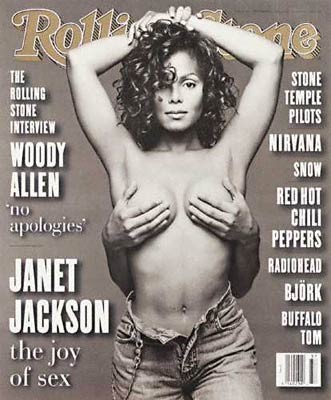
Media loves boorolling-stone-janet-jackson-coverbs - as long as they're shown in a sexual way. We're all familiar with advertising and other images of breasts. For example, this 1993 cover image of Janet Jackson on Rolling Stone won critical acclaim. The story focuses on Jackson and her embracing of her sexuality. The focal point is her breasts.

But a full 13 years later, BabyTalk magazine's cover created outrage. No less than 700 complaints were sent to the editor over a cover promoting breastfeeding. So getting it straight, a magazine committed to mothering and babies, getting flak over a cover which promoted - mothering and babies.

babytalk_cover_2006-08


In my paper I explain how I believe this has occurred. The movement of women into the public sphere has seen them embrace their femininity in a new way. There's a whole "look, I'm in the boardroom and I have breasts" ferocity which has been associated with feminism. Women don't like being confronted with images which remind them of the roles their mothers had. Feminism's abject failure through the 1980s and 1990s was its devaluation and disempowerment of the importance of nursing.

Yes, I argue that the feminist movement has contributed to a sociey where even women more readily accept images of breasts that celebrate them on a sexual rather than a mothering level. This is reflected in media too. TV programs such as Sex and the City, Desperate Housewives and Ally McBeal feature women who embrace their sexuality and power as successful. Women who hold traditional mothering roles are less successful, frustrated, angry or just plain stupid.

And then to have the audacity to bring those breasts, feeding infants, into the general public? No wonder women in general lead the call for 'discretion' and 'hooter hiders'.

The survey

I hoped to get about 30 responses. The survey went viral and in three days I received 128 responses. More than a third of respondents added extra information to each of the basic four questions asked. Women have strong views. In my paper I relate this passion to religiosity. The religion of breastfeeding meets all the academic standards of definition. No longer is breastfeeding normal, usual practice. And I find that distressing.

While 95% of respondents did not believe media has any influence over their own ideas about breastfeeding, more than half believe media should show it more often. Clearly, women believe media has an influence over someone (if not themselves). One key response was along the lines of "media doesn't influence my ideas about breastfeeding because it's not shown in media." My assertion is that this absence has just as much influence as if it were shown.


Moving forward
So what does this mean for feminists who embraced the bottle as their key to freedom from the ugliness and backward past? It means that the general public can look at American women and say "hey, are you women so stupid that you need to be told to breastfeed? And after eight years, you still aren't getting the message?" It means that heck, if you're an educated woman you need to recognise everything about you that's powerful, not just breaking through the glass ceiling.


If media showed breastfeeding as part of normal life on television and other media. If it made it present and normal - not a focus of a storyline, but just part of the everyday life of families with babies on tv, then could we begin to see this overtly sexual obsession with breasts change? Could we begin to see women being more accepting of their breasts as being a special part of a relationship with their child, not just as part of the relationship with their sexuality? If, in a similar way to Hollywood reducing smoking in movies, we began to insert breastfeeding into them... what would happen? And what about the international impact this could have? Hollywood movies are seen worldwide.

Certainly our only hope can be to improve on dismal American breastfeeding rates - and who knows where it could end.

My Blog List


Copyright © 2009 Mediamum | Green Scrapbook Diary Designed by SimplyWP | Made free by Scrapbooking Software | Bloggerized by Ipiet